When people first see an optimization running, they’re usually impressed by one number.
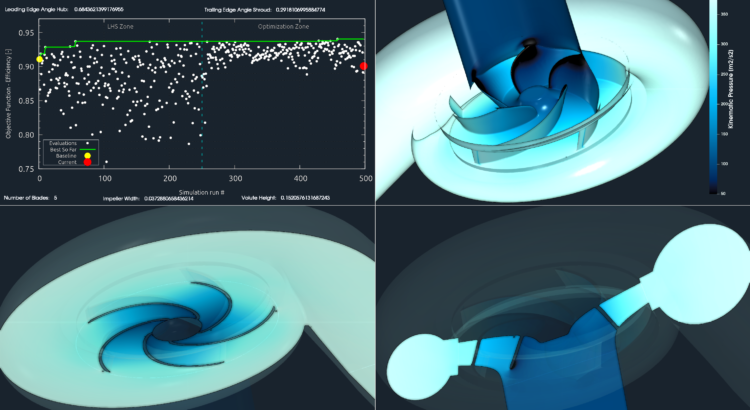
Five hundred CFD simulations.
That’s a lot of CPU hours.
A lot of electricity.
A lot of waiting.
Naturally, the next question is:
Was it worth it?
We don’t think that’s the right question.
When we look at an optimization, we don’t see hundreds of simulations.
We see hundreds of engineering hypotheses.
Each point asks a simple question:
What happens if we change this?
Most of those ideas will never become the final design.
Some make the product worse.
Some improve it only slightly.
A few are genuine breakthroughs.
At first glance, it might look like all the unsuccessful simulations were wasted (did you notice the smilie?).
They weren’t.
Every single one teaches us something.
One detail in the animation is easy to miss.
The workflow doesn’t immediately start searching for the best design.
It starts by exploring.
The first simulations are intentionally spread across the design space.
The algorithm is asking:
Before I optimize anything, I first need to understand the landscape.
Only after enough knowledge has been gathered does the strategy change.
Now it begins to exploit what it has learned.
Not because it has already found the answer.
Because it has reduced the uncertainty.
But there is another thought that has fascinated us recently.
What if those 500 simulations didn’t simply end with an optimized geometry?
What if every simulation became part of something bigger?
Every pressure field.
Every efficiency value.
Every failed design.
Every successful design.
Every trend hidden inside the data.
Instead of treating them as individual simulations, we could start treating them as accumulated engineering knowledge.
Suddenly, optimization is no longer just searching for one better pump.
It’s building an understanding of how pumps behave.
We think that’s one of the biggest misconceptions about optimization.
Optimization is not a search for the best design.
It’s a process of learning how a design behaves.
The optimized geometry is almost a by-product.
The real result is understanding.
Discover:
which parameters really matter,
which hardly matter at all,
where the sensitivities are,
where the trade-offs begin,
and perhaps most importantly, where it simply isn’t worth spending more engineering effort.
That knowledge doesn’t disappear when the project ends.
It becomes part of your engineering capability.
This is also where we believe the next chapter of engineering is beginning.
For decades we have used simulations to answer individual questions.
Today, we have the opportunity to learn from all of them together.
Not by replacing physics.
Not by replacing CFD.
But by preserving the engineering knowledge created by every simulation.
That’s exactly the philosophy behind one of the new directions we’re developing at CFDSUPPORT, called TBASE.
Instead of looking at every CFD simulation as an isolated project, TBASE treats it as another piece of engineering experience.
Another lesson.
Another experiment.
Another point contributing to a continuously growing engineering knowledge base.
Because the most valuable result of an optimization isn’t always the optimum.
Sometimes it’s everything you learned on the way there.
People often ask whether AI will replace optimization.
We don’t think that’s the interesting question.
Whether it’s Design of Experiments, surrogate models, Bayesian optimization, or AI, they’re all trying to achieve the same thing:
Reduce uncertainty.
Help engineers make better decisions.
That’s also how we’re trying to evolve CFDSUPPORT.
We don’t simply want to provide software.
Or consultancy.
Or another optimization algorithm.
We want to help engineering teams understand their products better, transfer that knowledge into their everyday work, and keep the most valuable asset exactly where it belongs:
Under their own roof.
Because software can always be replaced.
Engineering knowledge cannot.
Our mission at CFDSUPPORT is simple.
To help engineers make better decisions.
Sometimes that’s through software.
Sometimes through consultancy.
Sometimes it’s simply by sharing what we’ve learned.
Because engineering knowledge isn’t something to rent.
It’s something to build.
To keep.
And to pass on.
Have a wonderful summer.
Best regards,
Team CFDSUPPORT