NACA 0012: From Transonic CFD to an Aerodynamic Database

Transonic NACA 0012

The classical airfoil and a path from CFD to reusable engineering data.

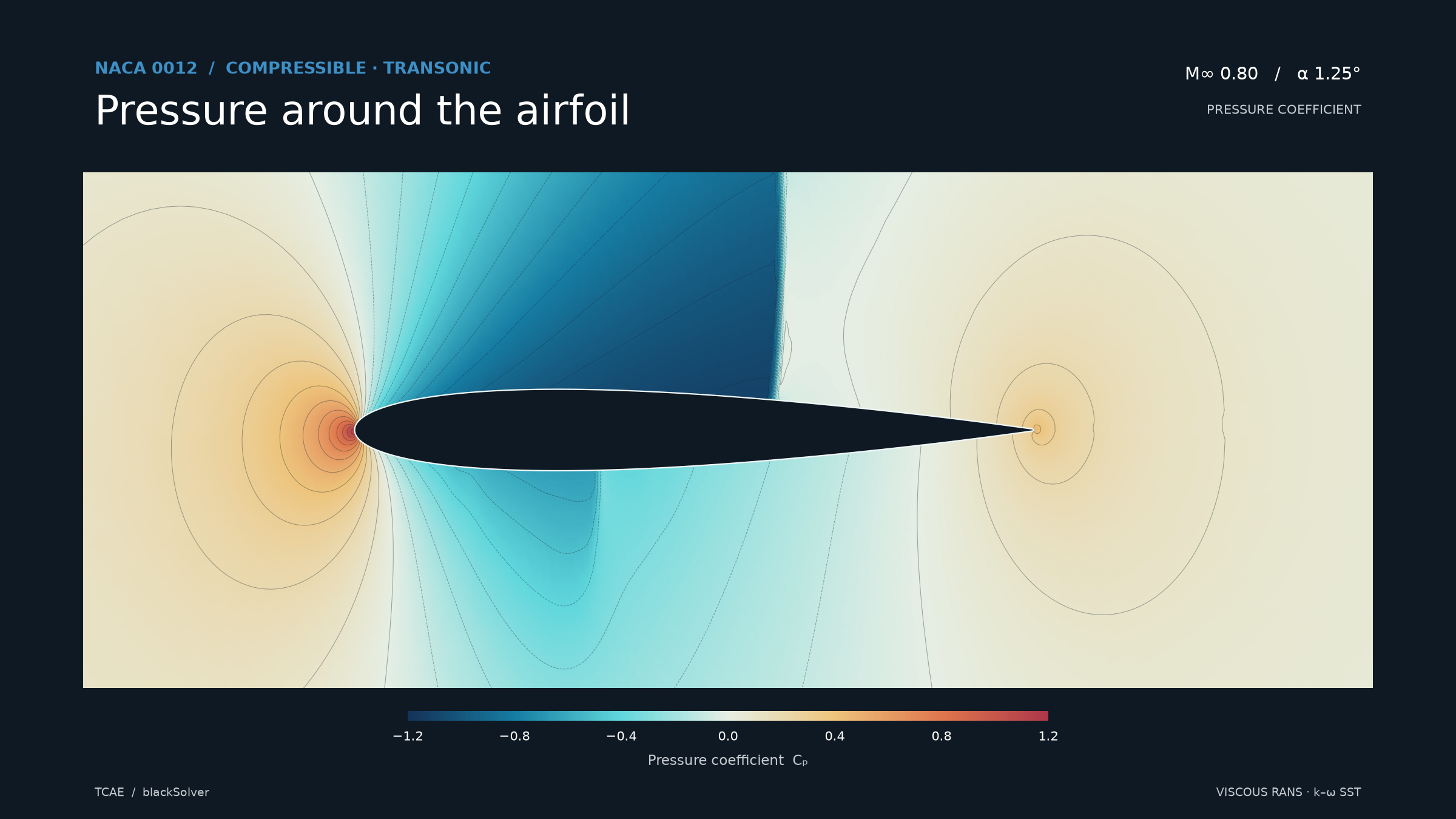
Pressure-coefficient contours around NACA 0012 at Mach 0.80 and angle of attack 1.25 degrees, supplied viscous RANS visualization.
Pressure coefficient Cp at the supplied reference condition, Ma = 0.80 and α = 1.25°. Source run and iteration: TO COMPLETE.

A transonic NACA 0012 case becomes a compact demonstration of a broader simulation workflow: 

  • understand the flow in TCAE
  • map its response to angle of attack and Mach number with TOPT
  • prepare the resulting dataset for TBASE

The complexity comes from connecting physics, repeatable execution, quality checks, data reuse, and future learning.

Case Setup

How much can the aerodynamic response change while the airfoil itself stays the same? This study explores that question through two operating parameters: angle of attack and freestream Mach number.

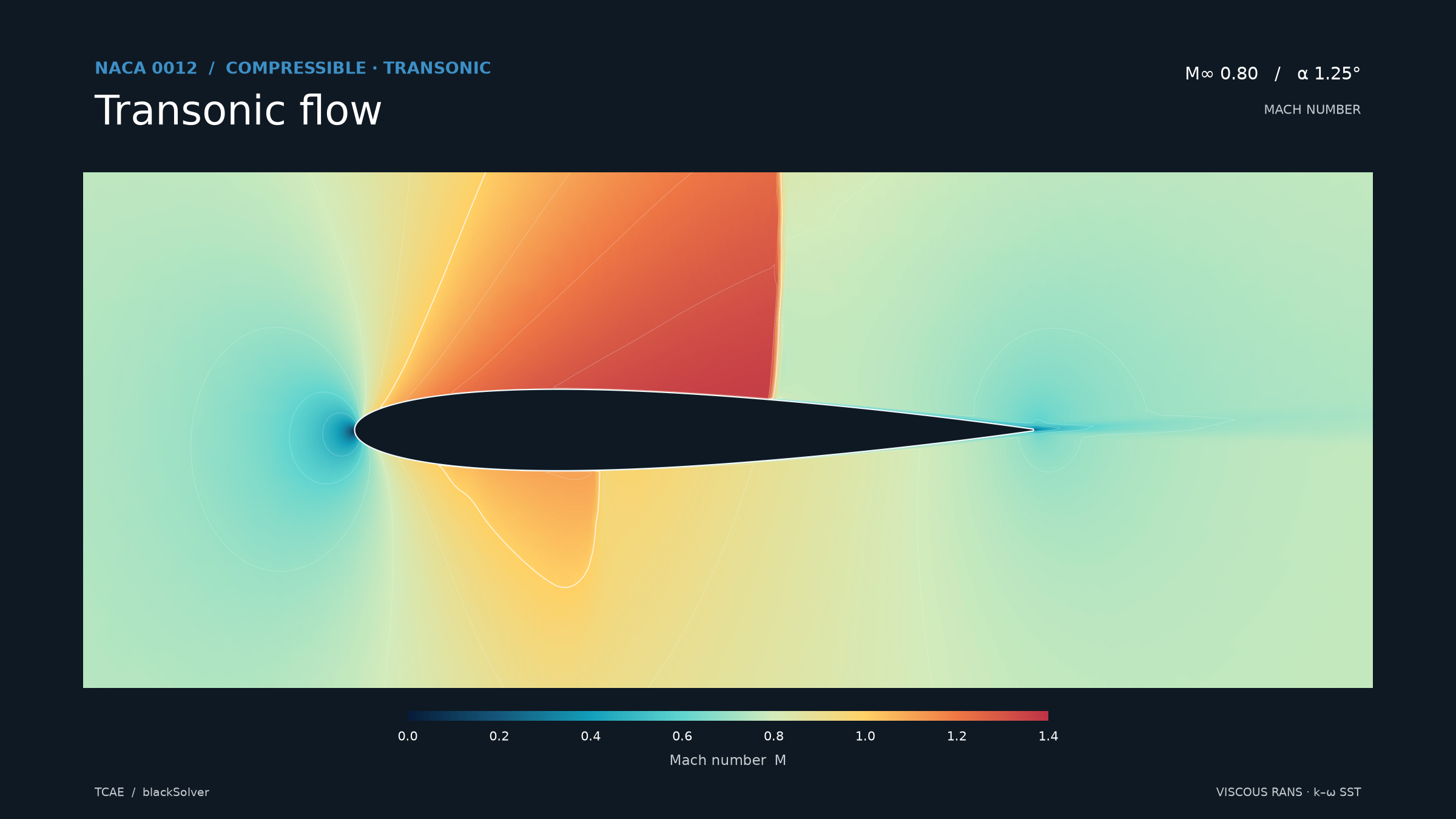
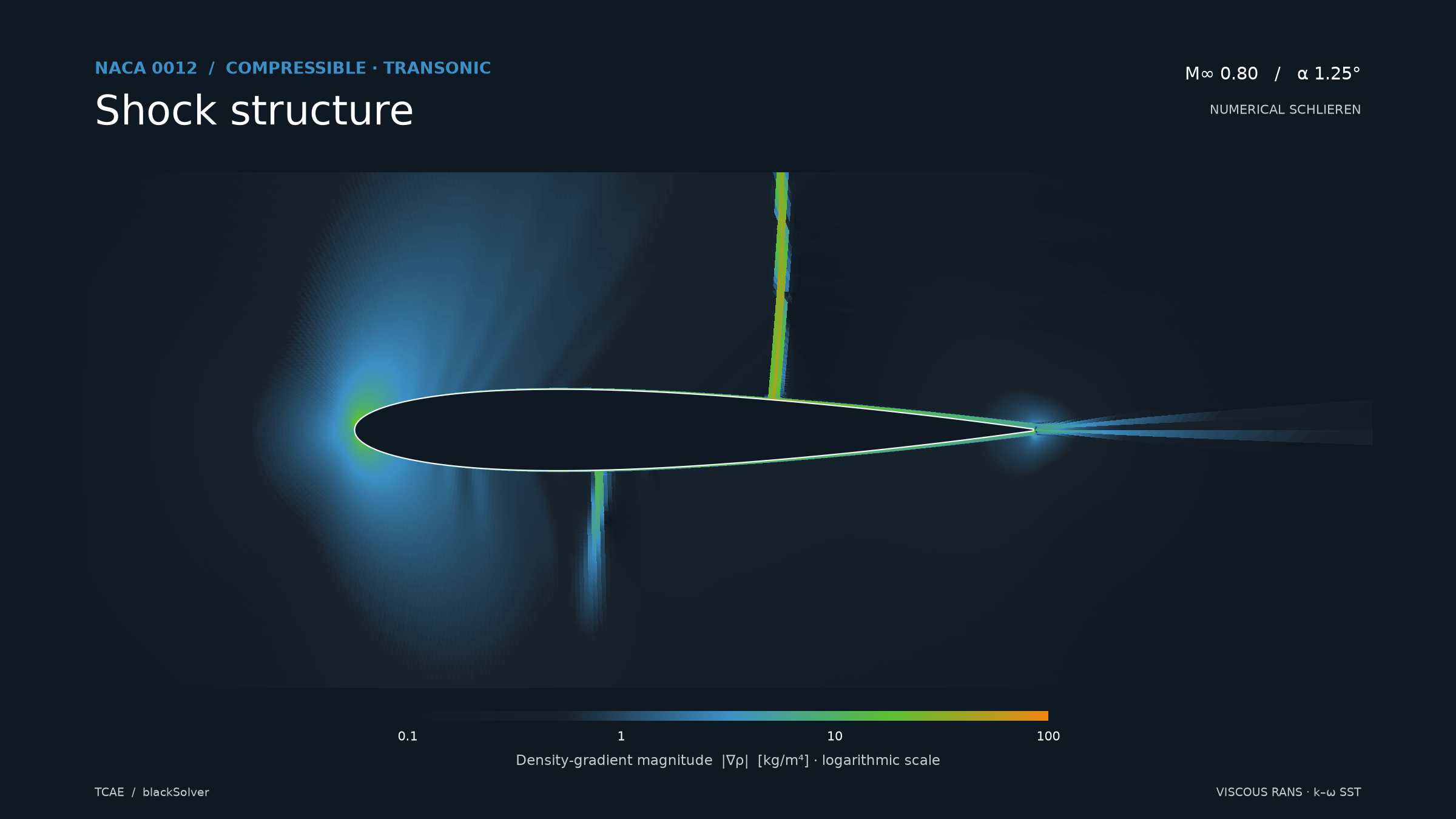
The supplied flow visualizations show the reference condition, Ma = 0.80 and α = 1.25°. Mach-number contours reveal the locally accelerated flow; pressure and shock visualizations provide complementary views of the same physical problem.

A common physical setup

The TOPT campaign uses the viscous, compressible blackSolver setup in TCAE with the k–ω SST turbulence model. It retains the existing nominal 120k-cell mesh and runs each point for 30,000 steady iterations. The airfoil is fixed; changing α rotates the freestream direction rather than the geometry.

Freestream pressure is 101,325 Pa, temperature is 288.15 K and the reference dynamic viscosity is 1.8 × 10⁻⁵ Pa·s. With these quantities fixed, changing Mach number also changes Reynolds number. This is an operating-condition study, not an isolated Mach sweep at constant Reynolds number.

What stays consistent: the mesh, geometry and physical model. Velocity boundary conditions, force directions and coefficient reference values are updated for each operating point.

Figures: supplied RANS visualizations at Ma = 0.80, α = 1.25°. TO COMPLETE — confirm the exact source run and iteration before final publication.

Mach-number contours around NACA 0012 at freestream Mach 0.80 and angle of attack 1.25 degrees; supplied viscous RANS visualization.
Supplied RANS visualization: Mach number, Ma = 0.80, α = 1.25°. Exact source run and iteration: TO COMPLETE.
Density-gradient visualization of the shock structure around NACA 0012 at Mach 0.80 and angle of attack 1.25 degrees, supplied viscous RANS result.
Shock structure shown through the density gradient. Supplied RANS image at Ma = 0.80, α = 1.25°. Source run and iteration: TO COMPLETE.

CFD MESH

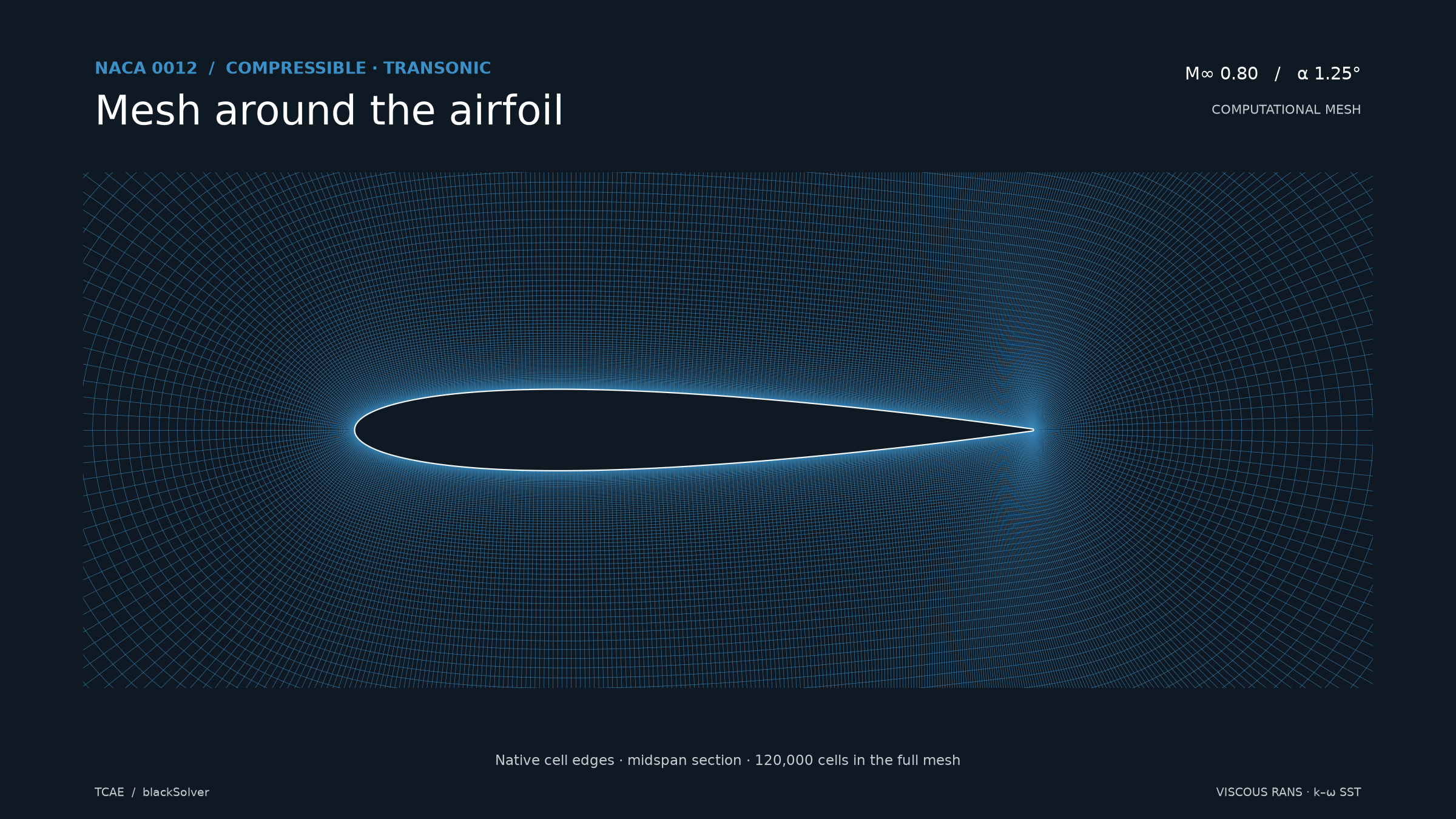
The baseline computational mesh contains 120,000 cells, confirmed in the CFD mesh data. The supplied midspan view shows body-fitted cells following the airfoil, with tighter spacing near the surface and around the leading and trailing edges. Spacing increases away from the profile.

Why reuse the mesh? The NACA 0012 geometry remains fixed. Angle of attack is prescribed through the freestream direction, while Mach number changes the freestream speed. TOPT can therefore evaluate all 15 operating points on the same mesh, without a remeshing step.

This keeps the spatial discretization consistent across the campaign. It does not establish mesh independence or adequate near-wall resolution.

TO COMPLETE: document mesh-quality metrics, assess mesh sensitivity and reconcile the measured y+ with the selected wall treatment before treating the dataset as validated.

Midspan view of the NACA 0012 computational mesh, showing body-fitted cells and refinement near the airfoil surface, leading edge and trailing edge.
NACA 0012 mesh: supplied midspan view of native cell edges. The CFD mesh contains 120,000 cells and is reused throughout the AOA–Ma campaign.

TOPT - Explore the operating envelope

TOPT turns the single case into a structured design of experiments. Five angles of attack are combined with three Mach numbers, giving 15 explicit operating points.

α: −2.50°, −1.25°, 0°, +1.25°, +2.50°
Ma: 0.75, 0.80, 0.85
Mesh policy: reuse the existing mesh; no remeshing.

This campaign explores operating conditions. It does not change the NACA 0012 shape and does not claim a globally optimal operating point.

From execution to an operating map

All 15 runs are marked finished in the TOPT report. The tracked outputs are lift coefficient CL, drag coefficient CD, moment coefficient CM and lift-to-drag ratio L/D.

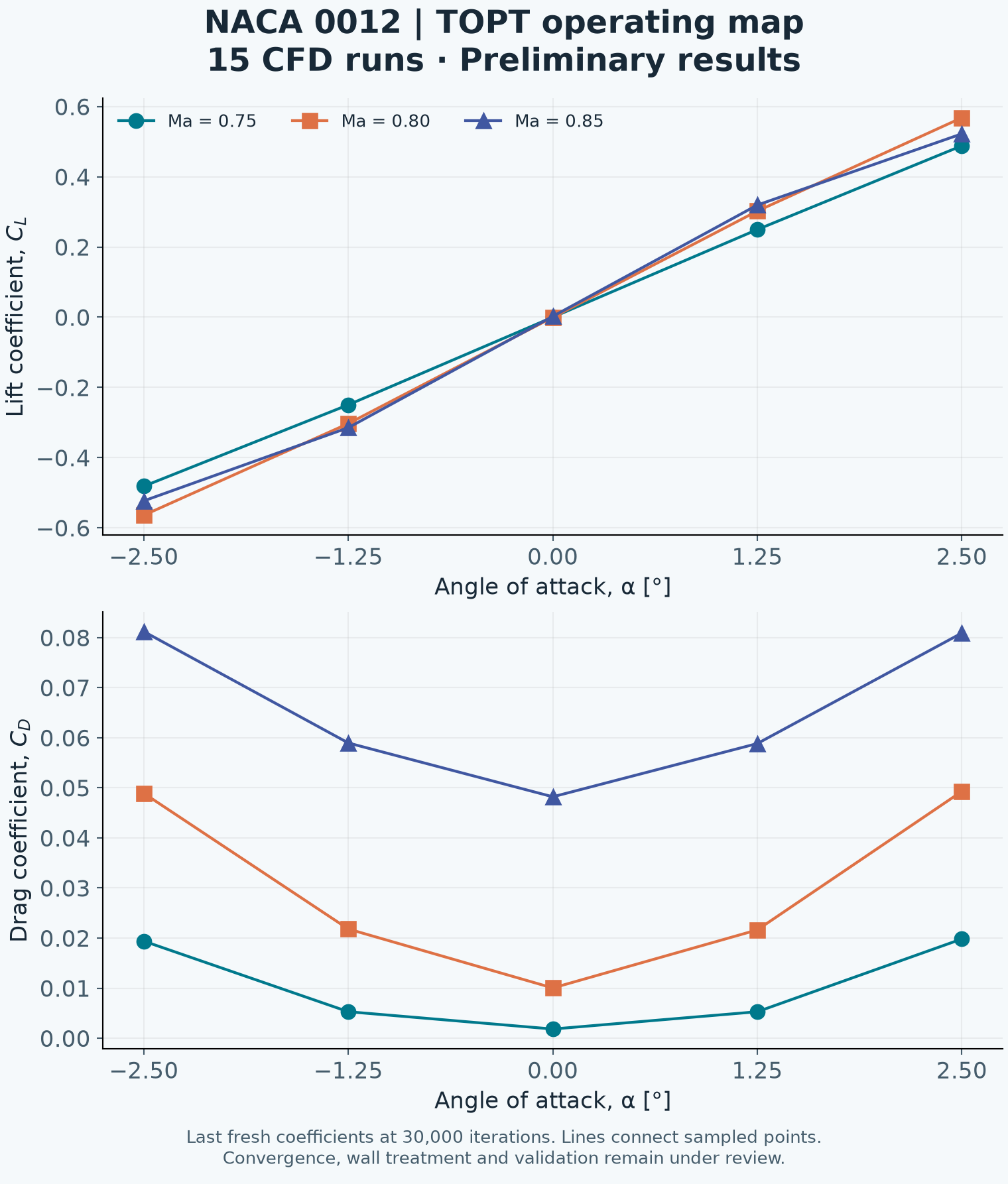
The adjacent chart uses the last freshly evaluated coefficients at 30,000 iterations. Each point was checked against the corresponding CFD output. Connecting lines only help follow the sampled points; they are not a surrogate prediction.

At α = 1.25°, the reported CD values are 0.00529, 0.02163 and 0.05884 for Ma = 0.75, 0.80 and 0.85 respectively. The preliminary dataset therefore shows a strong change in drag across this operating range.

Quality checks before reuse

Finished execution is one checkpoint. Some coefficient histories still vary near the end of the run. TO COMPLETE: convergence acceptance, mesh sensitivity, wall-treatment review and comparison with a suitable reference. At the reference point, the current mean airfoil y+ is approximately 47.8; its consistency with the configured low-Re wall treatment needs review.

No validated accuracy or optimization gain is claimed in this draft.
Preliminary NACA 0012 lift and drag coefficients versus angle of attack for Mach 0.75, 0.80 and 0.85, based on 15 TOPT CFD runs.
TOPT operating map: last fresh CFD coefficients at 30,000 iterations. Preliminary; convergence and validation under review.

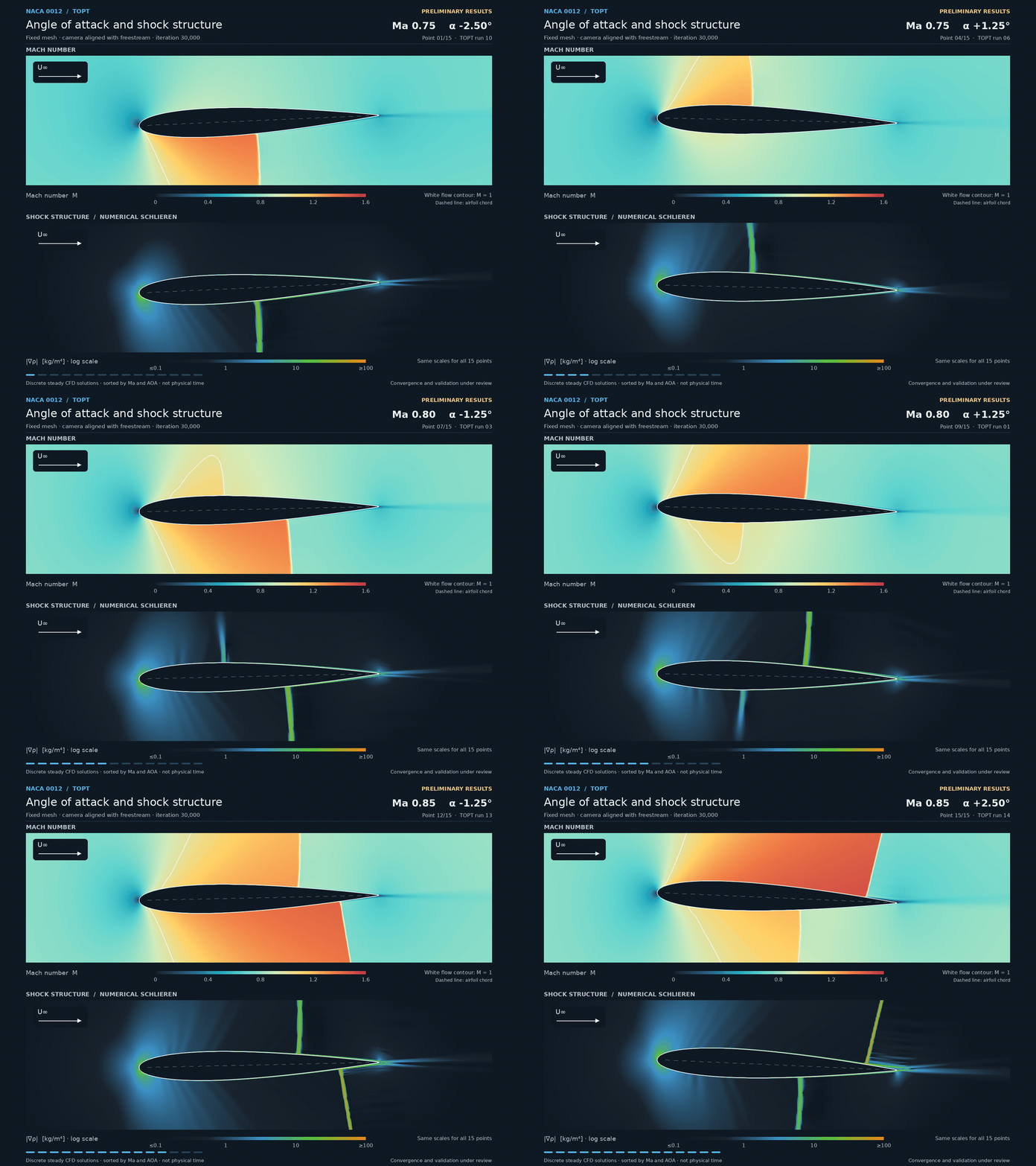
AOA, Mach number and shock structure

Animated ParaView comparison of Mach number and density-gradient magnitude for 15 NACA 0012 operating points, showing angle of attack and shock structure.
15 operating points, one fixed mesh. Mach number (top, white contour: M = 1) and density-gradient magnitude (bottom), rendered in ParaView at 30,000 iterations. The camera is aligned with the freestream to show AOA. Preliminary steady solutions; the sequence does not represent physical time.

TBASE - Turn runs into reusable knowledge

The next step is to connect every accepted operating point with its inputs, outputs and evidence. The intended TBASE dataset will pair α and Ma with CL, CD, CM and L/D, together with case provenance and quality status.

Current project status: TBASE import is not yet working. The panels below describe the planned continuation. They do not represent completed database or prediction results.

TO COMPLETE / 01 — Dataset import

Insert the actual TBASE dataset view after a successful import. Show the 15 source points, parameter units, coefficient definitions and traceable links to the underlying runs. Record which points pass the engineering acceptance checks.

TO COMPLETE / 02 — Explore the database

Insert a real TBASE view demonstrating how the accepted cases can be inspected and compared across α and Ma. Show the available coverage and identify gaps that require additional CFD.

TO COMPLETE / 03 — Test predictions

If a surrogate is trained, add predictions versus independently computed CFD points, the data split and quantitative error measures. Choose additional operating points for verification before presenting the model as useful between the original samples.

This closes the intended loop: simulate → review → organize → predict → verify with new CFD. The current case demonstrates the simulation campaign; the database and prediction stages remain future work.

Agent-assisted engineering

A traceable workflow, with engineering review

An agent can assist with preparing a parameter study and turning its outputs. In this project, the documented assistance includes preparing the AOA–Ma case setup, inspecting the resulting reports, checking the source of plotted coefficients and assembling this draft. TOPT executes the predefined campaign. Engineering decisions remain explicit: the parameter range, physical assumptions, acceptance criteria and interpretation of the results need human review. 

Download the TCAE + TOPT case

Explore the NACA 0012 setup and its AOA–Ma campaign in TCAE and TOPT.

Inside the case

  • The TCAE simulation setup and the fixed 120,000-cell mesh.
  • The 15-point TOPT design of experiments: five angles of attack and three Mach numbers.
  • Parameter mapping and tracking scripts for CL, CD, CM and L/D, plus a guide to the case assumptions.

Run the workflow

  1. Extract the archive into a new working directory and open the project in a compatible TCAE environment.
  2. Review the solver settings, wall treatment and available processor count. Check the setup before starting the campaign.
  3. Run the predefined TOPT study on the supplied mesh, then review convergence and coefficient histories for each point.

The package contains the TCAE/TOPT case only. TBASE import and database exploration are a separate future stage.

Prepared for review: a 19.4 MB ZIP archive. The extracted project passes setup checking in the development build TCAE 26.10rc0-782-g70bd79f8e. A full rerun of the packaged case and compatibility with a public release remain TO COMPLETE.

Download status: not yet released. The form below is a draft preview; final package approval and download delivery remain TO COMPLETE.

Privacy & Cookie Policy

Draft preview — download delivery is TO COMPLETE. No email or contact collection is enabled.