
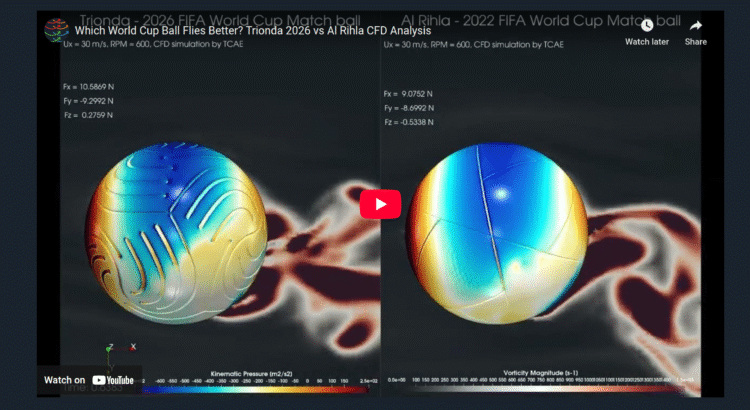
CFD Comparison of World Cup Match Balls: Trionda 2026 vs. Al Rihla 2022
At CFDSUPPORT, we enjoy applying Computational Fluid Dynamics (CFD) not only to industrial turbomachinery and engineering products, but also to iconic objects where physics meets global attention.
This time, we compared the aerodynamics of two official FIFA World Cup match balls:
Al Rihla – used at the FIFA World Cup 2022
Trionda – announced for the upcoming FIFA World Cup 2026
What did we simulate?
Using high-fidelity CFD simulations in TCAE, we analyzed the airflow around both balls across a range of realistic kick velocities and spin conditions. The focus was on:
Surface panel geometry and seams
Flow separation and wake structure
Aerodynamic stability and force fluctuations
Why does it matter?
Even small geometric changes in panel layout can significantly influence:
Ball stability in flight
Drag and lift behavior
Predictability for players and goalkeepers
These effects are subtle—but at elite levels of football, they matter.
Engineering insight beyond football
While this study is a fun and visually attractive example, the underlying physics is identical to what we solve daily in engineering applications:
External aerodynamics
Unsteady flow separation
Complex surface-flow interaction
It is a reminder that CFD is a universal tool—whether you are designing a pump, a turbine, or a World Cup ball.
Visuals & results
The simulations reveal distinct differences in wake topology and pressure distribution between Al Rihla and Trionda, directly linked to their surface design philosophy. Detailed flow visualizations highlight how modern ball development increasingly relies on numerical simulation rather than trial-and-error testing.