
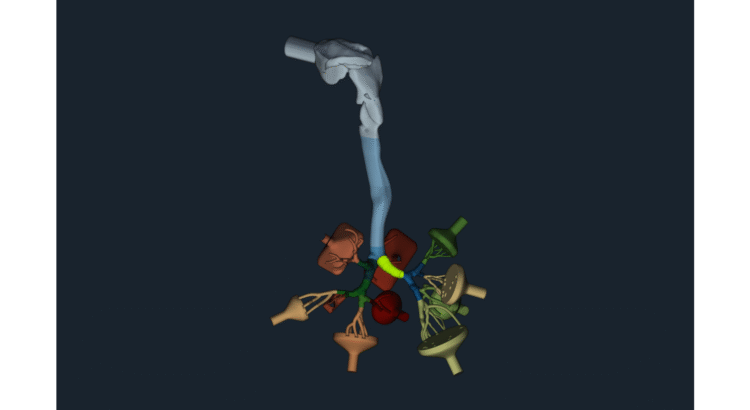
Human Upper Airways
The mathematical modeling and numerical simulation of respiratory flows present very complex and computationally expensive problem. One of the primary difficulties arises from the complicated branching structure of the bronchial airways. The intricate flow patterns and dynamics within this geometry require the generation of high-resolution computational grids, which are essential for performing detailed simulations of turbulent flows. These simulations have to accurately capture the large gradients in the solution fields, including flow jets, vortices, and boundary layers. Therefore, the accuracy of the solution is critically dependent not only on the quality of the grid but also on the numerical discretization methods employed. [2]
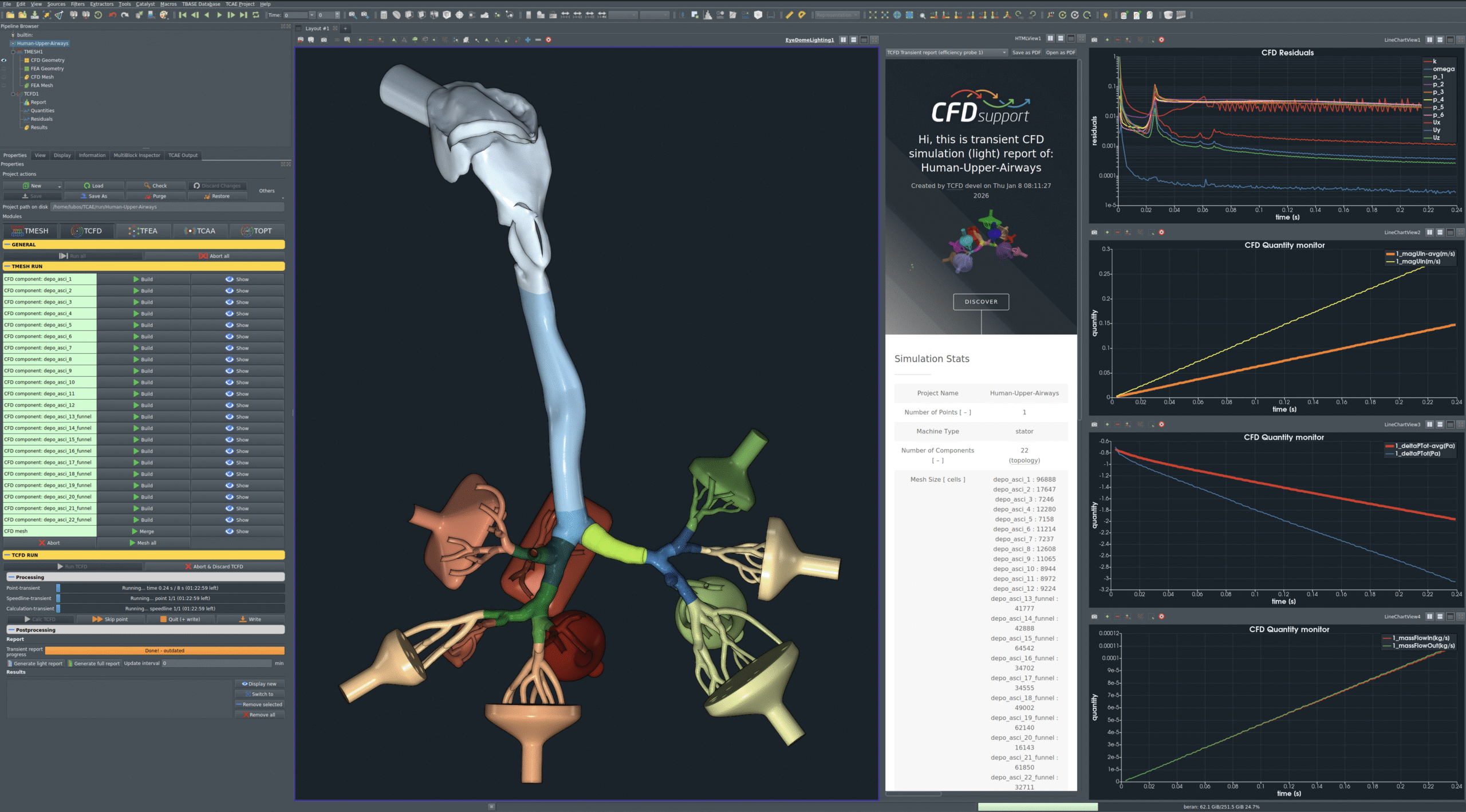
In the present shared case Human Upper Airways, the geometry, mesh resolution, and numerical setup have been deliberately chosen to provide a computationally feasible and user-accessible simulation framework.
The case is intended to be easily runnable with lower computational resources, making it suitable for demonstration. For this reason, the mesh quality and solver settings represent a compromise between numerical accuracy and computational cost.
It should be emphasized that this case does not aim to represent a fully optimized or physiologically detailed model of HUA. Further improvements would be required to enhance the physical realism of the simulations, including for example local mesh refinement in regions of high flow complexity, improved near-wall resolution, application of more realistic boundary conditions and so on.
The shared setup therefore serves as a baseline configuration.
The complete simulation workflow is executed within the TCFD GUI in ParaView, providing an intuitive environment for setting up, running, and monitoring the entire CFD pipeline. The CFD meshing is handled by the TCAE module TMESH, which manages the generation and customization of the computational grid. The CFD solver itself is operated through the TCAE module TCFD, leveraging the capabilities of the OpenFOAM open-source application to perform the numerical simulation.
This modular structure enables the user to build, adapt, and execute complex simulation workflows without leaving the unified interface. Moreover, the current setup naturally lends itself to extending the simulation with additional TCAE modules: TFEA for structural analysis, TCAA for aeroacoustics, and TOPT for design optimization. These modules can be seamlessly combined to explore fluid–structure interaction, acoustic, or automatization, depending on the specific research objectives.
Continue to the case study page >>>