
Dimpled Ball
A CFD and CAA analysis of flying & rotating ball
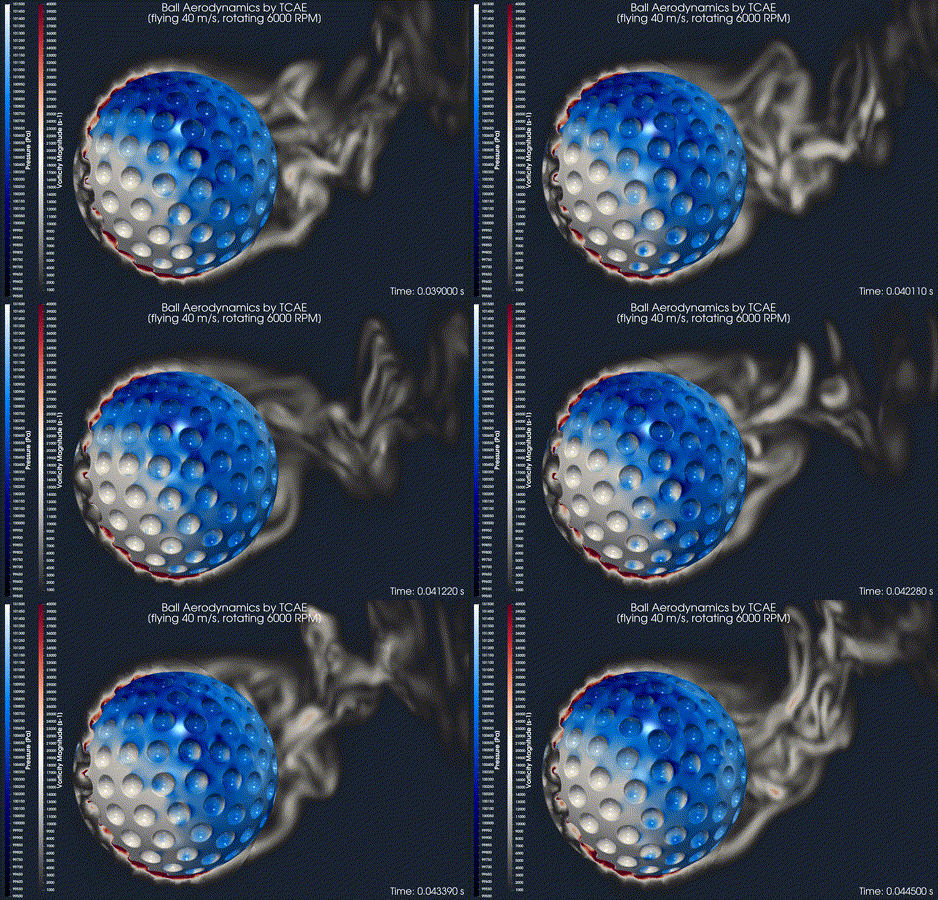
CFD Case Study: Flying & Rotating Ball – Virtual Tunnel Simulation
Welcome to one of our most exciting and comprehensive CFD case studies! In this project, we simulate the complex aerodynamics and acoustics of a flying and rotating ball using the Virtual Tunnel in TCAE. This transient simulation captures the detailed interaction of compressible flow with rotating components—ideal for studying flight dynamics, sports aerodynamics, or small UAV behavior.
The ball rotates at 6000 RPM and flies through the air at 40 m/s, while advanced κ-ω-DES turbulence modeling and resolved wall treatment ensure high-fidelity results. The simulation features a compressible Newtonian fluid model, capturing the real physics of air behavior at speed and under rotation.
But this study goes beyond just fluid dynamics, we also conducted a full Computational Aeroacoustics (CAA) analysis to evaluate noise generation and propagation caused by the spinning ball. This dual analysis (CFD + CAA) gives us a complete picture of both aerodynamic performance and sound emissions, crucial for applications in product design, sports engineering, and UAV stealth.
Key Setup Highlights:
⏱️ Transient, compressible flow
🪰 Flying
🔁 Rotating
🌪️ κ-ω-DES turbulence model with 5% inlet intensity
🔊 CAA analysis for acoustic footprint prediction
🧪 Air modeled accurately with real viscosity and density
💨 Virtual Tunnel environment with resolved boundary layers
- 💫 Magnus effect clearly visible in flow field
This case study showcases the power of modern simulation tools to capture not only how things move through the air—but how they sound.
CFD Simulation Setup
The CFD simulation is performed using the TCFD and TCAA modules in the TCAE simulation framework. The entire CFD simulation setup and execution are carried out through the TCFD GUI integrated within ParaView. TCFD uses OpenFOAM open-source application.
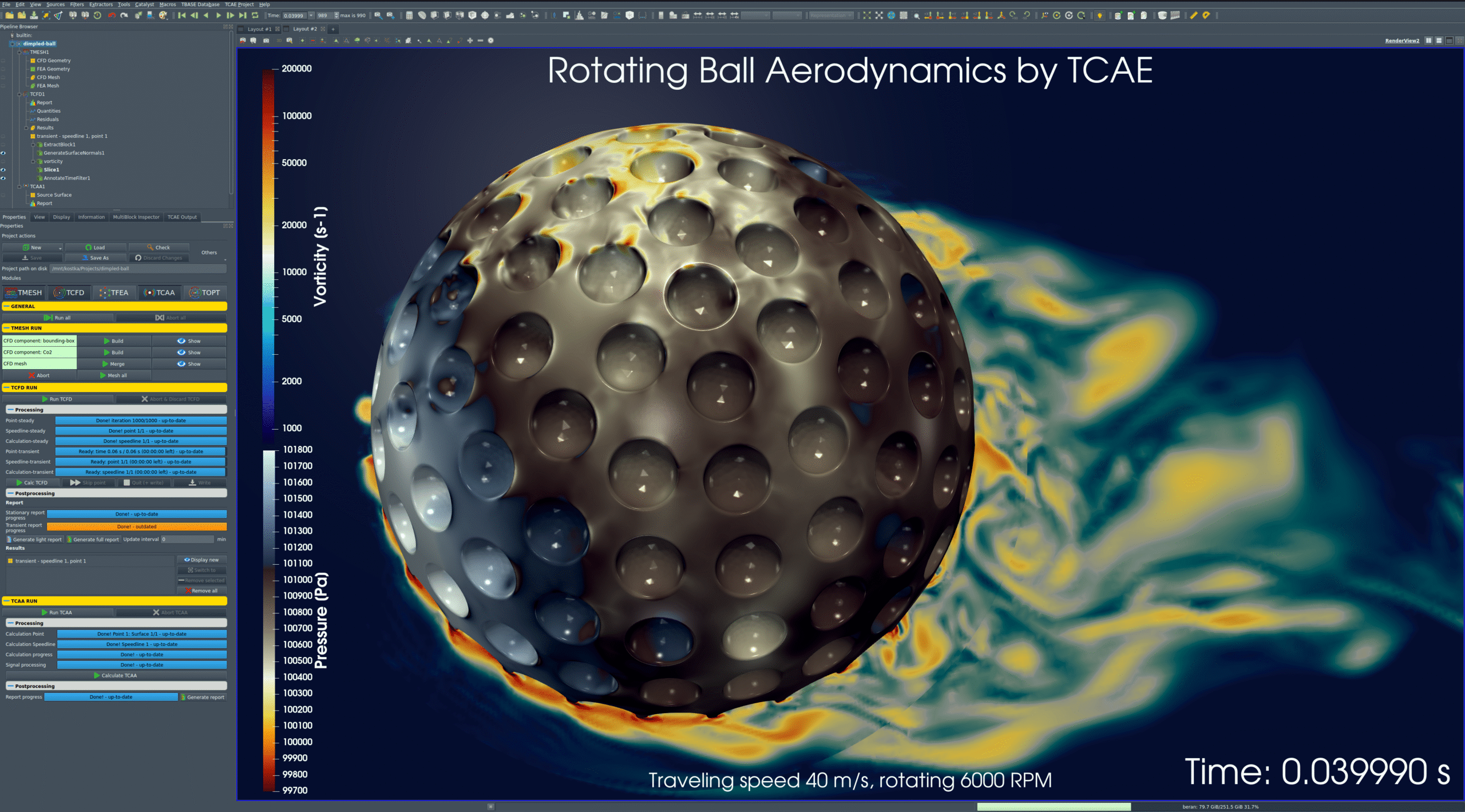
- TCAE Simulation type: Virtual Tunnel
- Time management: Transient
- Physical model: Compressible
- Number of components: 2 [-]
- Wall roughness: none
- Speed: 6000 [RPM]
- Inlet: 40 [m/s]
- Outlet: Static Pressure 1 [atm]
- Shear Thinnig model: Newtonian
- Turbulence: k-ω-DES
- Turbulence intensity: 5%
- Wall treatment: Resolved
- Speedlines: 1 [-]
- Simulation points: 1 [-]
- Fluid: Air
- Reference pressure: 1 [atm]
- Dynamic viscosity: 1.8e-5 [Pa.s]
- Ref. Air density: 1.2 [kg/m3]
The Magnus Effect in Action
One of the most remarkable phenomena captured in this simulation is the Magnus effect—the aerodynamic force responsible for the curved trajectory of a spinning object moving through a fluid.
As the ball spins at 6000 RPM and travels through the air at 40 m/s, a clear pressure differential forms around its surface. On one side, the rotation accelerates the airflow, reducing pressure, while on the opposite side, it decelerates the flow, increasing pressure. This imbalance generates a lift force perpendicular to the direction of motion, causing the ball to deviate from a straight path.
In our CFD results, the Magnus effect is vividly visualized in the asymmetric velocity field and pressure contours around the ball. It’s a perfect example of how rotation influences flight—essential in understanding the behavior of balls in sports, rotorcraft dynamics, and projectile motion in general.
This case study provides not only a theoretical demonstration but also a visually compelling and quantitative validation of the Magnus effect through high-fidelity simulation.
Conclusion
This case study of a 🪰 flying and rotating ball demonstrates the power and flexibility of modern CFD tools, particularly when combined with advanced turbulence modeling and aeroacoustics analysis.
Using the TCAE Virtual Tunnel, we successfully captured:
Detailed flow structures around a rapidly spinning object
The pronounced Magnus effect, responsible for the curved flight path
The aerodynamic behavior of a compressible, rotating system
The associated noise generation through dedicated CAA simulation
The simulation confirms that even highly dynamic and physically complex systems like spinning flight objects can be accurately modeled, visualized, and understood using high-quality CFD workflows.
This project not only validates the use of CFD for analyzing real-world rotational aerodynamics, but also highlights the potential applications in sports technology, drone design, and acoustic optimization.
📩 Ready to simulate your own idea?
Whether you’re developing high-performance sports equipment, a UAV, or an experimental component—CFD SUPPORT is here to help.
👉 Contact us today and let’s turn your concept into a powerful simulation!
References
Download TCAE Tutorial - Parametric Axial Blood Pump
File name: dimpled-ball-TCAE-Tutorial.zip
File size: 20.5 MB
Tutorial Features: CFD, CAA, TMESH, TCFD, SIMULATION, COMPRESSIBLE FLOW, TRANSIENT, AUTOMATION, WORKFLOW, SNAPPYHEXMESH, 2 COMPONENTS, 3D, Finite Volume, CFD, OpenFOAM, k-ω-DES, Magnus Effect