

CFD in the Age of AI: What Will Change, What Will Not
Artificial intelligence is changing our world as we know it. A storm of change concerns every field, everything, and everyone. In this little thought experiment, I would like to think about how our beloved Computational Fluid Dynamics (CFD) and CAE simulations are likely to change. I know, I know. Predicting the future is generally a foolish exercise, …, so I decided to write the following lines about it. Disclaimer: It’s March 2026.
At the moment, AI is entering CFD through at least three distinct paths, each affecting engineering work in a very different way: Agents, Surrogates, and Coding. These three guys are already happening, and they are quickly changing CAE, and the pace is only growing. Let’s take a look at them one by one.
AI Agents
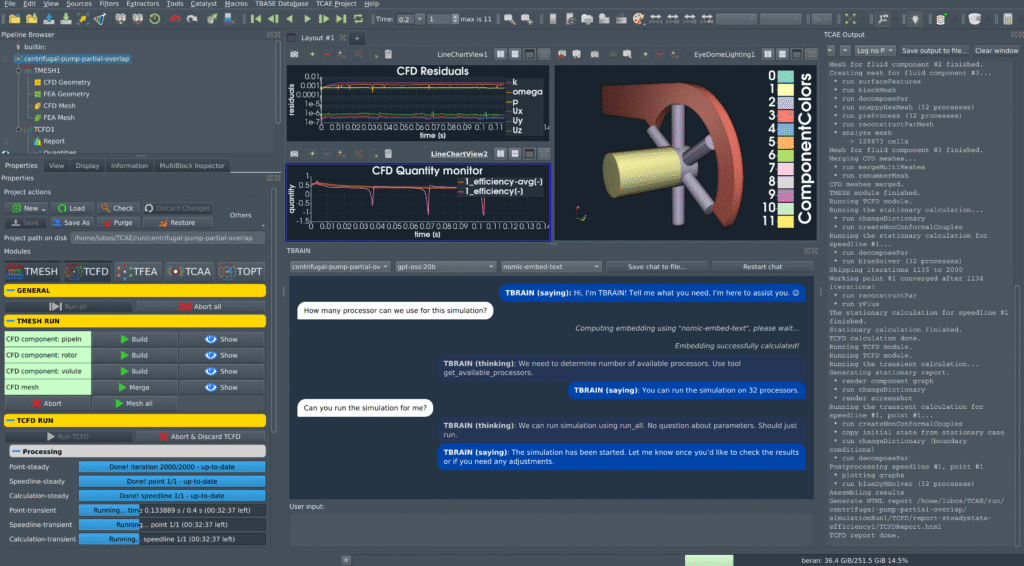
AI Agents support or partially mimic an engineer’s project work. Agents operate primarily at the workflow level. They assist with tasks such as case setup, mesh generation, simulation management, run, convergence monitoring, post-processing, sensitivity tests, and reporting. Their main contribution lies in the automation, consistency, and scalability of simulation projects. Agents also help to maintain the office knowledge in the long term. Disclaimer: Agents do not invent anything new; the physical foundations, like governing equations or boundary conditions, remain the same. Agents serve as an organizational and productivity layer around established simulation methods, helping engineers manage complexity and avoid annoying repetitive tasks, with low added value. Technically, agents act as classical LLMs in the user interface, and users talk to them via a chat window or voice.
Strengths: Reduce human errors. Large productivity increase. Shorten the time to solution.
Weaknesses: Not easy to develop. Risk of misconception. A long-term loss of human knowledge & skills.
Example: CFDSUPPORT’s software TBRAIN interface:
Surrogate models
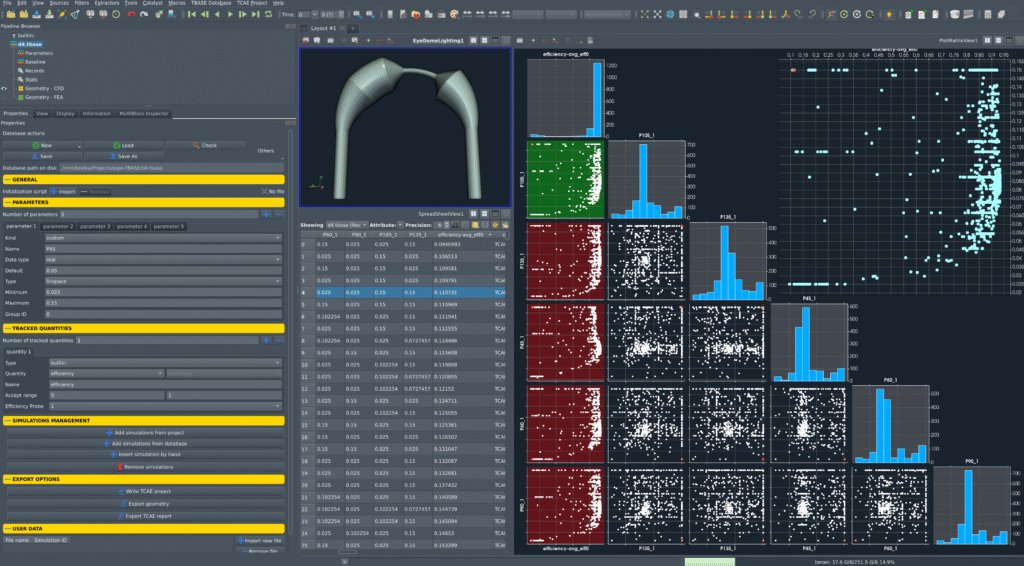
The next layer is Surrogate modeling, also described as Physics AI. Here, surrogate models and large foundational models are trained on simulation or experimental data to approximate the CFD results directly, without the need for demanding simulations. These models aim to predict flow behavior, or directly performance characteristics, or trends with significantly reduced computational cost. This makes them attractive for early design stages, parametric studies, and optimization workflows that require large numbers of evaluations. At the same time, Surrogates introduce new challenges. Their validity is greatly limited by the quality and coverage of training data, and their predictions outside known flow regimes (or geometry) are difficult to interpret and trust. Garbage in -> garbage out.
Strengths: Extreme speedup – seconds instead of hours/days. Can be used by non-experts.
Weaknesses: Need for quality data. Need for simulation history. Can’t use it on new projects.
Example: CFDSUPPORT’s software TBASE interface:
Coding
The third path is the most obvious. It’s way easier to code. With LLMs, writing code is becoming easier than ever. Tasks that previously required: lectures, reading books, searching existing code documentation, reading forums, and debugging for months, can now often be completed in minutes with AI assistance. CAE software development, or better, generating new code (solvers, boundary conditions, function objects, scripts, pre/postprocessing ) is no longer a barrier.
The technical threshold for getting MVPs working is clearly decreasing. … Does it mean that coding is becoming less important? No. It only means that the role of coding is changing. The difficulty is shifting from: getting writing code done to -> understanding what the new code actually does. AI can generate bug-free code that looks correct, runs without errors, and produces results. But it does not guarantee that the logic is correct, the assumptions are valid, or the results make any sense. These errors could be subtle and difficult to detect. As a result, coding becomes less about syntax and more about problem formulation, logical consistency, and, of course, verification of results. However, software time-to-market shrinks to a heartbeat. AI makes coding faster, but not automatically right. The ease of code generation even enhances the need for extensive validation, benchmarking, and physical measurement comparisons.
Strengths: A lot of new stuff quickly.
Weaknesses: Less deep understanding. Risk of misconception. A long-term loss of human knowledge & skills.
What Will Not Change (Anytime soon)
Fluid dynamics is a highly complex and inherently dynamic system from a mathematical point of view. CFD is, and will remain, an approximation. Every model has limits. Every result carries uncertainty. It is, and will remain, difficult to predict. This is not a weakness of CFD. This is its nature. Physics Will Always Matter.
Artificial intelligence is extremely powerful when working with what is artificial, synthetic, has patterns, and abstractions. AI loves many degrees of freedom. Physics is different. Physics follows the rules of nature, not the rules of art. Natural laws are ripped in stone. Nature does not reveal itself easily. At least not at a low price. Conservation laws, speaking via Navier-Stokes equations (partial differential equations of second order, parabolic-hyperbolic, non-linear) + Boundary conditions + Fluid properties, in 3D, are extremely difficult to solve. No matter how advanced the tools become, CFD will be difficult because its complexity is almost infinite.
Expertise will not disappear. This is good news (for experts). In CFD, the largest errors rarely come from numerical methods. They come from incorrect boundary conditions, unrealistic assumptions, and an incomplete understanding of the problem. This will not change. Experience will continue to outperform blind automation. Knowing what to simulate, and what not to simulate or where to stop, will remain a key skill. In the future, we will have (so) many more simulation results. That means the validation and verification will remain non-negotiable. And perhaps most importantly: It’s all about goals. Well-defined goals are everything.
What Will Change Significantly (already happening)
For any standard case, complete project automation will be the default. Routine parts of engineering workflows will be handled almost entirely by automated processes. Geometry preprocessing, mesh generation, case setup, execution of parametric studies, and regression testing will run with minimal manual intervention. Once a problem is properly defined, scaling it to tens or hundreds of variants will be straightforward. Then run, run, and run.
Standard cases will no longer be treated as individual simulations, but as fully defined workflows. As a result, project work will change significantly. The focus will shift from preparing and running single simulations to designing robust and reusable processes. Instead of working case by case, engineers will work with systems that generate, execute, and evaluate simulations in a structured and repeatable way.
Similarly to other fields, experts will be due to AI even more valuable, while junior positions could be challenged. Under this pressure, we can expect more and more complete project outsourcing to expert companies that are already extremely efficient in a particular expertise.
Exploration of design spaces will become a natural part of everyday work rather than single isolated runs or trial-and-error. Time-to-goals will shorten significantly.
At the same time, the volume of results will grow just as quickly, and understanding them will become harder, not easier.
Conclusion: CFD Will Remain the Art of the Possible
The value of AI in CFD is not that simulations become easier. The value is that engineers can focus on thinking, not clicking.
AI will increasingly act as an assistant, not an engineer. (Well, I am saying so in March 2026). It will suggest defaults, detect inconsistencies, help control convergence, build surrogate models, and accelerate optimization loops. These are HUGE improvements. At the same time, AI still does not understand physics & goals in the wide context. As well as it does not understand the responsibility and value/cost ratio. It does not sign & deliver final simulation reports.
The future of CFD is not AI instead of engineers; it is AI next to engineers. CFD workflows will continue to evolve. The traditional approach, one geometry, one mesh, one simulation, one result, is becoming less relevant. Engineering problems require parametric geometries, sensitivity analysis, optimization, and statistical evaluation. CFD is moving from single answers (trial-and-error) to design spaces.
Despite all these changes, the fundamental nature of CFD remains unchanged. It is still governed by physical assumptions, boundary conditions, and modeling choices. We should not expect a sudden increase in accuracy. Automation and surrogate models are based on generalization, and generalization does not improve accuracy for a specific case.
At the same time, human error (attention lost, typos, forgetting this and that) will decrease. And the need for experience, intuition, and engineering judgment will grow.
CFD has never been about perfect answers. It has always been about understanding, value/cost, comparisons, reducing risk, and supporting decisions. In the end, success will not be measured by solver speed or AI integration. It will be measured by something much simpler: better products and happy end users.
I know. I know. Predicting the future is generally a foolish exercise … let me know your thoughts on this, so we can fail together.
Luboš Pirkl
Prague, March 24, 2026